
Sonic Wand Ultrasonic Wand™ Technology Summary
The physical properties of ultrasound can explain the cavitation phenomenon and wave phenomenon. These two phenomena are summarized as follows.
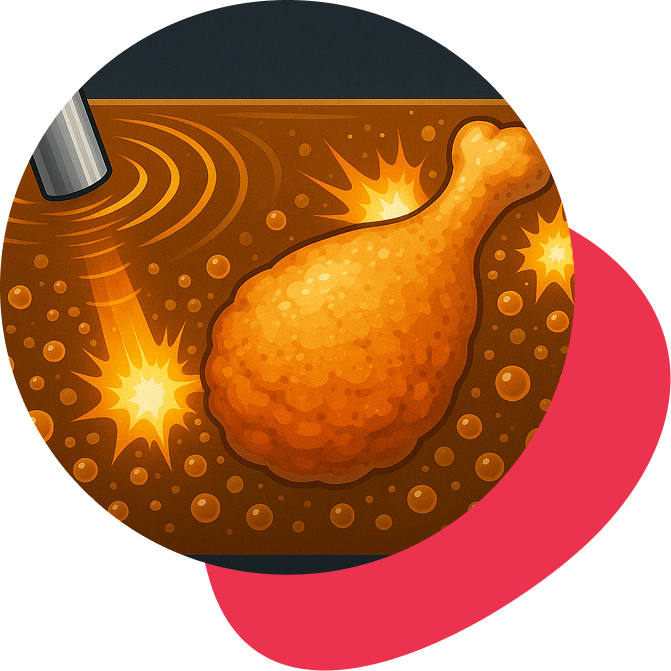
• Cavitation phenomenon
Ultrasonic waves repeat compression and expansion tens of thousands of times in a liquid, creating microbubbles → collapsing them
Main features:
-Local high temperature of over 6,000K and high pressure of over 2,000 atm occur when the bubbles collapse
-Physically stimulate the material surface or destroy tissue
-Mainly applied for washing, softening, extraction, maturation, etc.
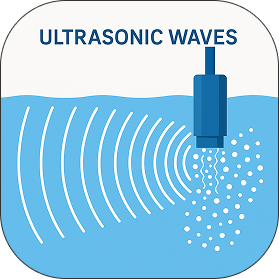
• Ultrasonic Wave Propagation
Ultrasonic waves are transmitted through the medium in the form of continuous sound pressure waves, and the phenomenon of penetrating energy into the material (vibration and interference)
Main features:
-Induces vibration (oscillation) of the medium
Accelerates heat transfer, causes physical disturbance, and causes mixing/dispersion effects
Contributes to boundary layer destruction/uniform heat transfer/maintains flavor, etc.
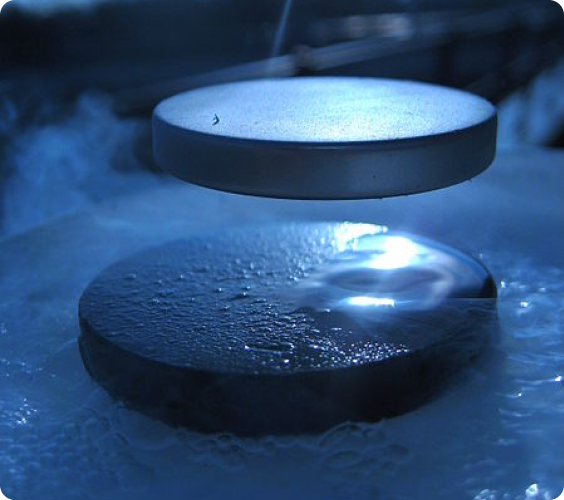
(C) Jubobroff
Why are Sonic Wand™ frying sticks different?
We have overcome the limitations of physics called Curie temperature.
If a superconductor has a phenomenon where its resistance disappears at a temperature of -200°C, an ultrasonic vibrator has a phenomenon where it loses its metallic properties by causing a transition temperature at a temperature of 150°C. This phenomenon is called the Curie temperature, and
Because of this phenomenon, existing ultrasonic fryer products could not be used at high temperatures above 160°C.
The Sonic Wand has been developed to withstand temperatures up to 220°C, allowing you to experience the special function of ultrasonic waves when cooking.
Effects on liquid dishes such as soups and stews
| Principle | Effect |
|---|---|
Cavitation Phenomenon |
1. Inhibits Oil Rancidity (Slows Oxidation) – Disperses oxygen contact to slow down rancidity – Suppresses peroxide formation → healthier fried food – Experimental result: ≥ 28% reduction 2. Reduces Harmful Substances (Oil Vapor, THC, TVOC) – Lowers oil vapor and volatile organic compounds when overheated – Reduced oil vapor → lower evaporation temperature – Experimental result: oil vapor – 75%, THC – 80%, TVOC – 47% 3. Improves Frying Quality – Achieves crispy exterior & tender interior, reduces oil uptake 4. Uniform Heat Transfer → Reduced Cooking Time – Instant high temperature and pressure accelerate heat transfer – Activated convection flow shortens cooking time by approximately 20–30% 5. Less Odor Absorption – Less odor clings to clothing/body 6. Reduces Oil Splatter – Fine waves stabilize frying 7. Lowers Oil Viscosity – Viscosity ↓ 5.5% → extra crispiness, easier cleanup 8. Odor Removal – Oxidizes/decomposes odor particles → improves kitchen hygiene |
| Principle | Effect |
|---|---|
Wave Phenomenon (Wave)
|
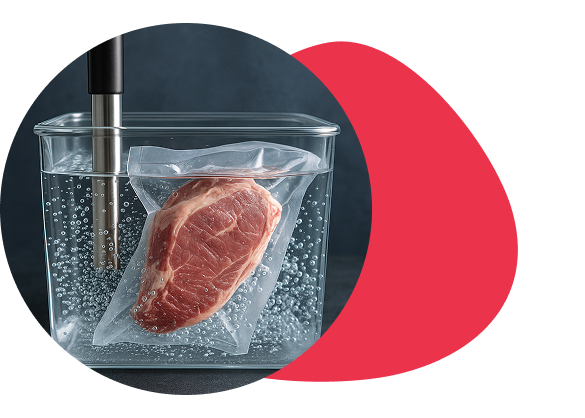
1. Suppresses Oil Burning Phenomenon – Micro-vibrations and cavitation inhibit interactions between odor particles and oil – Disperses or evaporates flavor compounds before they adsorb into the oil – Cavitation bubbles aid in removing odor particles – Bursting bubbles oxidize and break down odor compounds – Enables a wider variety of frying styles, improving kitchen efficiency 2. Tenderizing Effect – Micro-vibrations induce stress within tissue – Micro-tearing of muscle fibers and weakening of connective tissue → softer texture – Reduces tenderizing time by 40–60% during low-temperature aging 3. Accelerates Enzymatic Reactions – Vibrations create local changes in temperature and pressure within the tissue – Promotes activation of protease enzymes – Shortens the aging process and speeds up softening |
Effects on liquid dishes such as soups and stews
Cavitation for depth, waves for evenness.
Ultrasound is a scientific tool that boosts both speed and quality in cooking soups and stews.
| Principle | Effect |
|---|---|
| Cavitation Phenomenon (Cavitation) |
1. Rapid Extraction of Deep Broth Flavor – Quickly extracts flavor compounds under high-temperature, high-pressure conditions 2. Micro-Disruption of Ingredient Surfaces → Promotes Extraction of Nutrients & Flavor – Releases more taste and nutrients from meat, seafood, bones, etc. 3. Cooking Time Reduction (Over 30%) – Accelerates heat transfer to reduce overall cooking time 4. Off-Flavor Removal – Decomposes fats and blood components to mitigate unpleasant odors (e.g., fishiness) 5. Breakdown into Easily Digestible & Absorbable Structures – Softens tissues and converts them into a state favorable for absorption in the body |
| Principle | Effect |
|---|---|
| Wave Phenomenon (Wave) |
1. Uniform heat transfer → broth is heated evenly throughout 2. Reduces temperature gradients between ingredients → prevents hotspots or cold spots in the broth 3. Induces cell-membrane vibrations → accelerates movement of nutrients and flavor compounds 4. Minimizes odor transfer → maintains a clean taste even when boiling various ingredients together 5. Helps create a clear, non-greasy broth |
| Item | Cavitation | Wave |
|---|---|---|
| Main Location | Points where microbubbles form in the broth | Waves propagate through the entire liquid region |
| Mode of Action | Explosive localized stimulation | Vibrational continuous energy |
| Purpose | Rapid extraction, tissue disruption, off-flavor removal | Heat uniformity, enhanced cooking stability |
| Perceived Outcome | Deep, rich broth; rapid infusion | Even cooking and clean taste |
Effects on matured preparations such as sauces and alcoholic beverages
| Principle | Effect |
|---|---|
| Cavitation Phenomenon (Cavitation) |
1. Breaks down or micronizes particles in alcohol or sauce (sediments, flavor compounds) 2. Disrupts or activates molecular structures of proteins, enzymes, and oxidants 3. Accelerates the aging process by 3–5× 4. Reduces bitterness and raw off-flavors while enhancing smoothness 5. Decreases astringency (tannins) in wine and harsh alcoholic aromas in spirits |
| Wave Phenomenon (Wave) |
1. Promotes uniform micro-mixing of components within the liquid 2. Increases diffusion rate of flavor molecules during maturation 3. Enhances molecular activity at low temperatures without heat change 4. Ensures consistent sauce consistency and prevents layer separation 5. Produces an overall smooth and consistent taste profile |
Comparison Summary
| Item | Cavitation | Wave |
|---|---|---|
| Primary Action | Particle breakdown, molecular stimulation, promotion of localized reactions | Bulk mixing, vibrational propagation, induction of uniform reactions |
| Main Results | Reduced maturation time, off-flavor removal, flavor enhancement | Flavor uniformity, harmonious aroma, improved stability |
| Temperature Effect | Operable at low temperatures (non-thermal processing) | Reaction activation possible without heating |
- Wine: Reduces astringency and stabilizes aromas (10 minutes of ultrasound → effect similar to 3 years of aging)
- Soy sauce, Doenjang, and other sauces: Shortens maturation time, breaks down sediments, smooths flavor
- Whiskey and Makgeolli: Decreases harsh “distillate” notes, enhances aged aromas, imparts a premium quality
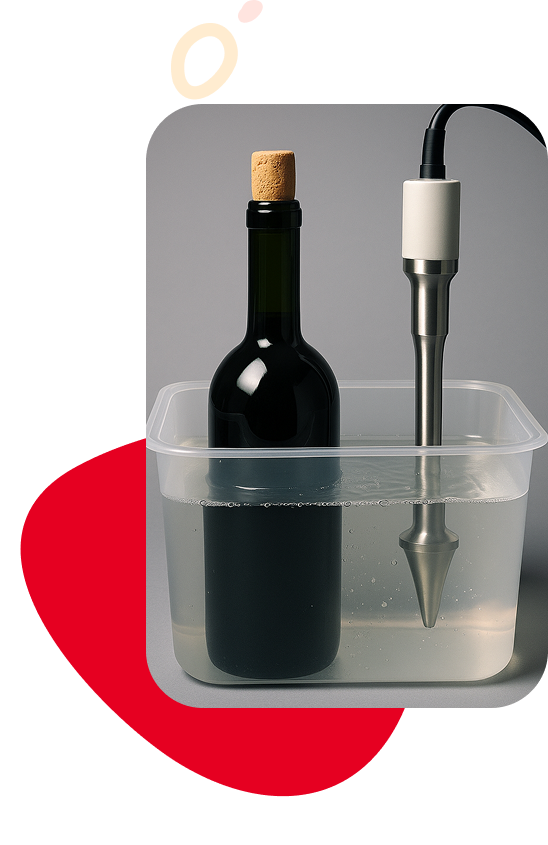
Why the taste changes even when ultrasound is applied outside the wine bottle?
-
Transmission of Ultrasonic Vibrations via the Container (Bottle)
Ultrasound propagates far more effectively through solids and liquids than through gases.
When you emit ultrasound into water, the waves travel: water → glass bottle → the wine inside.
Especially if the bottle’s base or side is close to the ultrasonic probe, the entire bottle vibrates minutely, and those vibrations transfer into the wine.
👉 In other words, the ultrasound “rides” the bottle and, via indirect contact, stirs the liquid within. -
Delivery of Acoustic Energy through Solid Glass
Ultrasound transmits acoustic energy through the elastic medium of the bottle material (glass or plastic).
When the bottle resonates with the sound waves, waves are induced in the liquid inside, causing micro-vibrations and mixing. -
Wave Energy Drives Molecular Motion in the Liquid
These micro-vibrations encourage the dispersion and rearrangement of tannins, ethanol, organic acids, and aroma compounds in the wine.
As a result, the taste becomes smoother and acquires a more mature flavor profile. -
Molecular Reorganization Occurs Without Heat
Because this process doesn’t raise temperature, the wine’s alcohol structure and aromas remain intact—and in fact the flavors are cleanly refined in a very short time.
Practical application example
| Application Example | Observed Changes |
|---|---|
| Ultrasonic treatment by immersing a wine bottle in water | Reduced astringency, smoother aroma, enhanced aged character |
| Also applicable to makgeolli, soju, whiskey, etc. | Off-flavor removal, improved mouthfeel, reduced fermentation odors |